

Should Gutter Installation in Malta, NY Happen at the Same Time as Your New Roof?
The situations described here are composites drawn from the types of jobs and decisions we encounter regularly. Names and specific figures are illustrative.
A two-story colonial in Malta, built in 2003, still had its original roof and its original gutters: about 168 feet of 5-inch seamless aluminum, hung on spikes and ferrules. The roof was scheduled to be replaced in early November. The roofer’s estimate had a line for detaching and resetting the gutters, about $400 on this job. The homeowner wanted to know whether to pay that and keep the old gutters, or treat it as the time for gutter installation in Malta, NY and put up a new system once the shingles were done. The number that framed the decision was 168 feet at our published rate of $8 to $12 per foot for 5-inch aluminum, which works out to roughly $1,350 to $2,000.
This is one of the most common questions we get in the fall. In our experience, a lot of roof replacements around Saratoga County get booked between September and the first snow, and on many of those houses the roof and gutters went up in the same year, so they have been aging on the same clock. The question homeowners ask is simple: should the gutters be replaced with the roof, or can they wait?
What the house actually had
Before anyone talks about price, it helps to look at the age of each part against how long that part normally lasts. A USDA Forest Service reference table on building component life puts asphalt shingles at 15 to 30 years and gutters and downspouts at about 30 years[1]. On paper, that meant the roof on this house was due and the gutters had some years left.
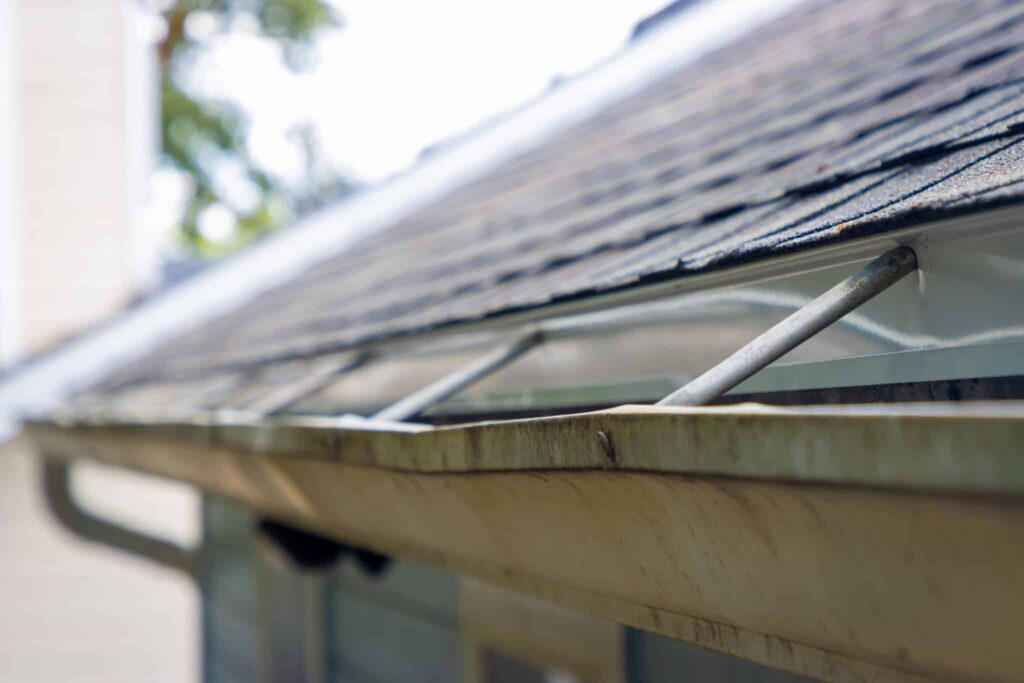
Those numbers told only part of the story. When we walked the house, the aluminum itself was in fair shape. The paint had chalked on the south side, but there were no holes, and the seamless runs had no joints to fail except at the corners. The hangers were a different matter. On the front, over the garage, five spikes had backed out far enough that the gutter dipped in the middle of the run. On the back, the spikes were spaced about 32 inches apart. This Old House notes that hidden hangers are typically spaced about 24 inches apart, and describes a repair job where brackets spaced 30 to 32 inches apart were the reason the gutter sagged[4]. That matched what we saw.
Why the roof job changes the gutter math
Most homeowners think of the gutters and the roof as two separate jobs. At the eave, they overlap. Drip edge, the metal strip at the edge of the roof deck, has been required on shingle roofs at the eaves and gables in the International Residential Code since its 2012 edition. That code section says the drip edge has to extend at least a quarter inch below the roof sheathing, and the underlayment has to lap over it at the eaves[2]. New York’s 2020 residential code was built on the 2018 edition of that same model code[3]. So on a full tear-off, the roofer is working right at the line where the gutter hangs.
The ICC’s explanation of that code change says drip edge directs water away from the fascia and rake trim[2]. In practice, that only works if the gutter sits where the water comes off. We covered the basics in an earlier piece on why drip edge matters for protecting your gutters. On a reroof, the drip edge position is often a little different from what was there before, and an old gutter that gets reset to its old screw or spike holes may not line up with the new edge.
The other thing a roof job does is expose the fascia. With the gutters off, every board along the eave is visible for the first time in years. On this house, two sections of fascia were soft: one behind the sagging garage run, and one at the back corner where a downspout elbow had leaked. That rot would have been hidden again if the old gutters went straight back up.
Reset or replace: how the two options lined up
Here is how the two choices compared on this house. The prices are specific to this job. The new-gutter range comes from the rates we publish on our seamless gutter installation page.
| Reset the old gutters | New 5-inch seamless after the roof | |
|---|---|---|
| Cost on this job | About $400 reset fee, plus hanger repairs | About $1,350 to $2,000 for 168 feet at $8 to $12 per foot |
| Hangers | Old spikes in old holes, or new holes in old fascia | Hidden hangers, closer spacing |
| Gutter age after the job | 23 years | New |
| Warranty | None on the old metal | Our 5-year workmanship and 20-year manufacturer finish warranty |
The reset was the cheaper option by more than a thousand dollars. That matters, and we said so. If the gutters had been 10 years old, on hidden hangers, with sound fascia behind them, we would have told the homeowner to pay the roofer’s reset fee and keep them. A newer system that goes back up cleanly can easily last the life of the new roof.
This house didn’t fit that picture. The reset would put 23-year-old gutters back on old spikes, over fascia that needed repair, on a new roof expected to last decades. And with the gutters at 23 years against a typical life of about 30[1], a full replacement was likely within the life of the new shingles anyway. That second job would mean another round of work at the eave of a brand-new roof.
“We don’t do roofing, and we’ll tell you that up front. Every install we do includes a fascia check, and tearing off and hauling away the old gutters is part of the price.”
Oleg Sandul, Owner, United Gutters
That second point decided it. The homeowner was going to pay to have the old gutters taken down either way, through the roofer’s reset fee. Paying for a new system meant the old one came off and left the property, and the fascia got looked at board by board before anything new went up.
How the week actually went
Sequencing is where these jobs go well or badly. The order that worked here was simple, and it is the order we use on most reroofs:
| Day | Who | What happened |
|---|---|---|
| Day 1, morning | Gutter crew | Old gutters and downspouts taken down and hauled away |
| Days 1 to 3 | Roofer | Tear-off, two fascia sections replaced, drip edge, underlayment, shingles |
| Day 4 | Gutter crew | Fascia check, new seamless runs formed on site, hidden hangers, downspouts |
Taking the gutters down first kept the roofer from having to work around them, and it kept tear-off debris from landing in a system that was going to the scrap pile anyway. Putting the new gutters up last meant they hung against the finished drip edge, not a guess about where it would end up.
On day four, the runs were formed on the truck to the exact lengths of each wall, so there were no joints except at the corners. InterNACHI’s guidance is that gutters should slope toward the downspout at about a quarter inch per 5 to 10 feet[5], and the hangers were set to that pitch, at closer spacing than the old spikes. The garage run that had been dipping in the middle now drained to its outlet. The downspouts went back at the same four corners, with extensions; how we size those is covered on our downspout installation page. The install took one day.
What homeowners usually ask at this point
The first question is almost always whether the roofer can just do the gutters too. Some roofing companies do, and some sub it out. What we tell people is to ask who is forming the gutters and what hangers they are using, and to get the gutter price as its own line. If the roofer’s number for new gutters is close to ours, that’s fine. The point is to compare it against something.
The second question is whether the gutters can go up later, in the spring. They can. Hidden hangers are screwed into the fascia[4], so a later gutter install doesn’t have to disturb the new shingles. The cost of waiting is a winter with either no gutters or the old ones reset. InterNACHI notes that a few inches of rain on a roof can produce several thousand gallons of runoff, and that downspouts should carry water 4 to 6 feet away from the foundation[5]. A Capital Region house with no gutters from November to April sends all of that, plus snowmelt, straight down along the foundation.
The third question is about size. Some homeowners assume a new roof means going to 6-inch gutters. On this colonial, the roof planes were moderate and the old 5-inch system had not been overflowing except where the garage run sagged, so 5-inch stayed. Larger roofs, steep pitches, or valleys that dump into one corner are where 6-inch earns its extra cost.
The last question is about the fascia. Homeowners often don’t know theirs is soft until the gutters come off. When it is, the repair belongs before the new gutters go on, and on a reroof the roofer is usually the one set up to replace it. We wrote about how this damage develops in how gutter failures damage fascia and siding.
What we took from this one
The decision was not really about whether the gutters were worn out. By the USDA table they had some years left[1]. It came down to three things that were specific to this house: hangers that were already failing, fascia that needed work anyway, and a reset fee that bought nothing but the old system back on the wall.
If your gutters are fairly new, on good hangers, with solid wood behind them, the reset fee is usually money well spent and replacing them would be hard to justify. If they are past 20 years, sagging in spots, or you already know the fascia is soft, the roof job is the cheapest time you’ll get to deal with it, because the gutters have to come down regardless. Either way, it helps to have someone look at the eave before the roofer’s crew arrives, not after.
For homeowners weighing a new roof this fall and wondering about gutter installation in Malta, NY, the honest answer is that it depends on the hangers and the fascia more than on the calendar. If you’d like that looked at, you can find details on our gutter installation services here.
Sources
- Typical Life Expectancy of Building Components, USDA Forest Service, Building Condition Assessment and Documentation
- Significant Changes to the 2012 International Residential Code: R905.2.8.5 Roof Drip Edge, International Code Council (2011)
- 2020 Residential Code of New York State, International Code Council and New York State Department of State (2020)
- How To Fix Sagging Gutters, This Old House
- Inspecting Gutters and Downspouts, International Association of Certified Home Inspectors (InterNACHI)
