

Could Gutter Repair in Albany, NY Have Prevented a Foundation Crack After the July 2026 Floods?

The situations described here are composites drawn from the types of jobs and decisions we encounter regularly. Names and specific figures are illustrative.
The puddle appeared against the back wall of the house after the first rain following the floods. She had lived there for years and it had never done that. The explanation seemed obvious: the soil was saturated. That is a reasonable first thought and it is often wrong. A close look at gutter repair in Albany, NY after July’s rainfall usually starts with the question of where the water was going before it reached the ground.
A system built for a normal storm
From July 28 through 30, 2026, the Capital Region took a historic rain event. The National Weather Service recorded 5.45 inches at Albany on July 29, the second-wettest day on record there, and about 7 inches over the three days. Parts of Columbia and Rensselaer counties saw nearly a foot. First responders performed water rescues, and a historic grist mill collapsed.
A standard residential gutter system is generally sized for rainfall rates on the order of an inch or so per hour. When several inches fall in a day, the arithmetic stops working. Water overflows, runs behind the gutter, saturates the fascia and sheets down the foundation wall in place of the downspouts.

What the inspection found at the back of the house
By late August the puddle had company: a visible crack in the basement wall and seepage during moderate storms. That was when she called for a gutter inspection. The inspector found that the July downpour had shifted the pitch of the gutters along the entire back of the house. Three hangers had pulled partway out of the fascia and two joint connections had separated. Water that should have flowed along the run to a downspout was instead rolling over the edge and landing against the foundation.
Even a small change in pitch alters drainage, and the combined weight of water and debris in a storm is enough to pull hangers loose, especially from fascia that has been wet for days. The same thing can happen to any older sectional system. A write-up on how gutter failures damage fascia and siding on Albany homes shows what that looks like over time.
The gutter repair in this illustration, which covered resetting hangers, replacing a short section of fascia, resealing two joints and adjusting the pitch, came to $650. The foundation crack repair that followed cost $2,400. A homeowner in that position might reasonably conclude that checking the gutters in August could have avoided the foundation work. The cost comparison supports the idea: gutter work was a fraction of the other repair and was the cheaper problem to catch.
A walk-around for after a storm like July’s
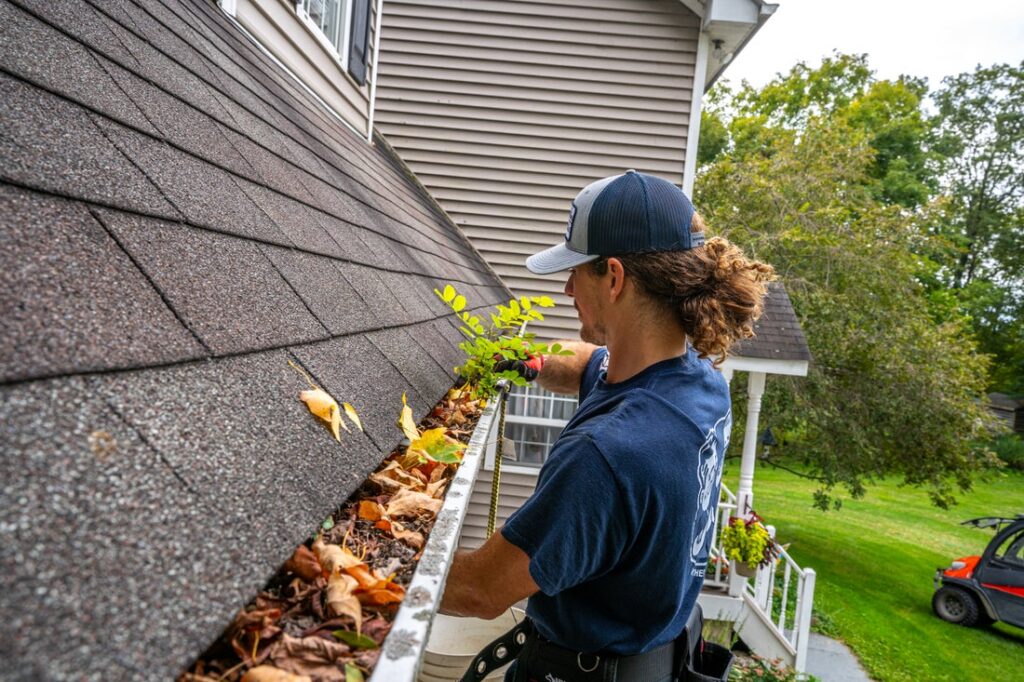
Five things are worth checking, and they work as a short walk-around. Start with pitch: water that pools instead of flowing toward the downspout means the run has shifted. Walk the length of each gutter and look for gaps at joints, since small separations leak even in normal rain. Press on the fascia behind the gutter. If it gives, it has started to rot and will not hold hangers much longer. Check each downspout for a firm connection at the outlet and for water leaving the house at least a few feet from the foundation. Then look at the ground near the foundation for new erosion, displaced soil or staining that was not there before July.
Upgrade or repair?
Homeowners in this situation usually ask whether to simply fix what failed or to upgrade. For systems with 5-inch gutters, many consider moving to 6-inch seamless aluminum, which carries more volume and has fewer joints to separate. The page on gutter installation explains the options, and gutter guards keep debris from clogging a system during a storm, when nobody can safely get up a ladder to clear it.
Water leaving the house matters as much as the gutter itself. A downspout that discharges beside the foundation can undo the work of a good gutter. Another case is told in how a Delmar wet basement came back to a bad downspout. Where existing downspouts are short or broken, downspout installation with longer extensions is often among the less expensive fixes.

Why the timing is before the first freeze
Water that got behind the gutters in July and into the fascia is still in the wood. When freeze and thaw cycles start, it expands and contracts, widens gaps and speeds rot. A gutter that is only slightly off now can pull away under ice and snow loads in January. A routine gutter cleaning visit in the fall is also a chance to check pitch and hangers, which is why many homeowners combine the two.
The takeaway from the story is practical. After a storm like July’s, do not assume the ground is the problem. Look up first. Few people think about gutter repair in Albany, NY until something fails, but gutters are often the first thing a heavy rain breaks and the last thing anyone checks.
If you’re looking for gutter services in Albany, you can reach out here.
Sources
