

What Are the Top-Rated Gutter Guards for Heavy Rain Protection?
Summary
- Micro-mesh with a reinforced frame handles peak flow better than foam or basic screens.
- Downspout sizing and outlets are as critical as the guard in heavy rain.
- Upstate NY rooflines need snow/ice-compatible designs and valley splash control.
- Costs vary by roof complexity; maintenance drops but never falls to zero.
- Evaluate overflow patterns and debris mix before choosing a product type.
Introduction
We install, service, and repair gutter systems across Saratoga Springs and greater Upstate New York. Our crews work through spring cloudbursts, summer thunderstorms, fall leaf drop, and long freeze–thaw cycles. Heavy rain is not a general concept here; it is a set of predictable patterns that expose weaknesses in gutter guard design, installation technique, and roof geometry.
This article shares what we trust in the field when rainfall intensity spikes and downspouts must move water fast. We focus on product categories and installation strategies that withstand our local conditions. No national rankings or brand scorecards—just what has held up on real homes we maintain.
Why gutter guards matter specifically in Saratoga Springs and Upstate New York
In Saratoga Springs, we typically see fast-moving cells that dump short, heavy bursts in late spring and mid-summer. In fall, leaf drop coincides with cold rains, and early snow can bridge over poorly supported guards. Ice ridging at the eaves shows up later, stressing weak panels. Without the right guard and downspout plan, gutters overflow at inside corners and valleys, cutting trenches in mulch, staining siding, and sending water toward the foundation.
We also deal with mixed debris: maple and oak leaves, pine needles around the Spa State Park area, seed pods, twigs, and grit shed from shingles. The right guard reduces that mix while still admitting enough water during peak downpours. The wrong guard clogs, sheets water over the lip, or collapses under snow weight.
Common misconceptions about gutter guard effectiveness in heavy rain
- “Any micro-mesh guarantees no overflow.” Not in our region. Mesh pitch, aperture size, internal support, and how water transitions from the roof to the guard all matter.
- “Reverse-curve always moves water faster.” Only if the nose geometry matches your roof pitch and the fascia is straight. In cold snaps, the curve can ice up and stall flow.
- “Foam inserts are foolproof.” Foam can absorb fine shingle grit and deform under snow load. We regularly remove foam that has compacted and choked the gutter channel.
- “Bigger gutters alone solve heavy rain.” 6-inch gutters help, but poorly sized outlets or undersized downspouts still bottleneck flow.
Gutter protection options that actually perform well in heavy rain
Mesh vs micro-mesh in heavy rain
We distinguish between coarse mesh (screen-style) and micro-mesh (stainless steel, fine aperture).
- Coarse mesh: Admits high water volume but also allows seed pods and needles to wedge. Works on homes dominated by broadleaf trees and moderate rain, less so with pines and grit.
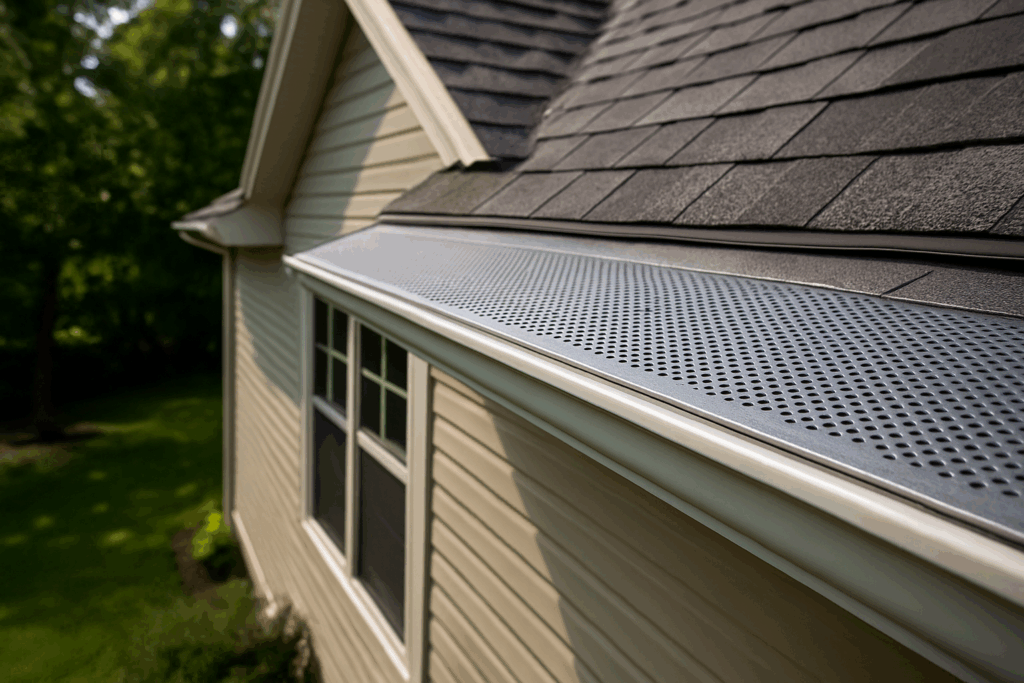
- Micro-mesh with reinforced understructure: Balances filtration with flow. When the frame has an angled profile, a stiff spine, and a clean hand-off from roof edge to mesh, we see strong performance in Saratoga Springs cloudbursts.
In our installs, micro-mesh with a rigid support rail and a slight forward slope handles peak rainfall while keeping out needles and asphalt granules. Flat, flimsy micro-mesh tends to pond and overflow during August storms.
Foam vs reverse-curve compatibility with snow and ice
- Foam inserts: Quick to install but degrade under UV, trap grit, and compress under snow. Heavy rain after a thaw exposes the reduced gutter capacity. We consider foam temporary in Upstate New York.
- Reverse-curve (surface tension): Moves water well in steady rain if slopes are right. In freeze–thaw, the nose can bridge with ice, pushing water over the edge. Debris can also cling to the curve. We install these selectively on simpler rooflines with manageable winter shading.
Our bottom line: For Upstate winters and Saratoga Springs downpours, micro-mesh with a robust frame is the most reliable category. We often combine it with splash guards at inside corners and oversized outlets.
Performance tradeoffs: water volume, debris, and roofline compatibility
| Guard Category | Heavy Rain Capacity | Debris Resistance | Snow/Ice Behavior | Roofline Fit | Maintenance |
|---|---|---|---|---|---|
| Coarse Mesh Screen | High initial flow | Moderate; pods/needles intrude | Can deform under snow loads | Simple eaves, fewer valleys | Seasonal brushing |
| Reinforced Micro-Mesh | High with proper slope | High; blocks needles/grit | Stable if framed; less ice catch | Most rooflines; excels at valleys with splash control | Low; occasional rinse |
| Reverse-Curve | High in steady rain | Moderate; debris can cling to nose | Nose can ice; overflow risk | Straight runs; limited valleys | Low–moderate; nose cleaning |
| Foam Insert | Moderate when new | Declines as foam loads with grit | Compresses; capacity lost | Short-term or mild debris sites | High; frequent replacement |
Roofline details drive outcomes. Steep pitches accelerate flow and can overshoot flat guards. Valleys feed concentrated streams that demand splash guards or valley diverters. Complex eaves with multiple dormers call for stiffer guard panels to avoid sagging.
Seasonal rain patterns in Saratoga Springs and what they mean
We plan for three stress points:
- Late spring–early summer: Short, heavy bursts that expose weak outlet sizing and poor transitions from shingles to guards.
- Late summer thunderstorms: High-intensity, 10–20 minute events where inside corners and valleys overflow first.
- Autumn leaf drop with cold rain: Guards must shed leaves while admitting water; sagging or flat guards will sheet water over the edge.
What overflows mean for your foundation and structure
- Foundation: Persistent overflow saturates soils along the footing, increasing hydrostatic pressure at basement walls.
- Walkways and steps: Splash-back causes spalling and surface scaling over winters.
- Siding and fascia: Repeated wetting stains aluminum and rots wood soffits at drip points.
We treat chronic overflow as a system problem, not just a guard problem. In many homes, the choke point is the outlet or the number and routing of downspouts.
Cost vs value for protection, labor, and maintenance
Installed costs vary by eave height, roof pitch, fascia condition, and add-ons like splash guards or outlet upgrades. Below is a ballpark comparison we observe in Upstate New York:
| Option | Typical Installed Cost (per linear foot) | Expected Maintenance | Notes |
|---|---|---|---|
| Coarse Mesh | $6–$10 | Seasonal blow-off | Budget choice; watch for needles and pods |
| Reinforced Micro-Mesh | $12–$20 | Annual inspection | Best balance for heavy rain + debris mix |
| Reverse-Curve | $15–$22 | Annual nose cleaning | Roof pitch dependent; winter sensitivity |
| Foam Insert | $4–$8 | Frequent replacement | Short service life under snow/UV |
We often pair guard installs with outlet enlargements to 3×4 downspouts and add inside-corner splash guards. Those upgrades reduce emergency maintenance during peak storms. For more on debris types and how downspout repairs factor into total cost, see our discussion of pine needles vs leaves and downspout repair costs.
Top recommended product categories for this region
Based on our installs in Saratoga Springs and across Upstate New York, these categories rise to the top for heavy rain performance:
- Reinforced stainless micro-mesh with angled frame: Admits peak flow, resists needles and grit, and stands up under snow. We favor designs with a small leading lip that tucks cleanly under shingles without lifting tabs.
- Valley splash solutions: Metal splash guards or deflectors at inside corners to handle concentrated valley discharge.
- Oversized outlets and 3×4 downspouts: The guard can only do so much if the exit is a bottleneck. Enlarging outlets is one of our highest-ROI upgrades.
- 6-inch K-style gutters where fascia height allows: More cross-sectional area for peak events, especially on larger roofs.
If you want a deeper dive into payback and maintenance reduction in our area, we’ve addressed whether gutter guards in Upstate NY are worth it under real maintenance budgets.
How to tell if heavy rain protection is needed for your property
- Overflow stripes on fascia or tiger-striping on the gutter face after storms.
- Mulch displacement or soil trenches below inside corners.
- Basement dampness localized to one side after heavy rain.
- Standing water at downspout exits or water backing up at the outlet.
- Pine needles matted at the eave; fine grit collecting on the guard or in the gutter channel.
We also pay attention to roof geometry. Long valleys aimed at short gutter runs almost always need splash control and larger outlets.
Scenario breakdowns we see repeatedly
| Scenario | Risk in Heavy Rain | What We Do |
|---|---|---|
| Two-story colonial with long front valley | Inside-corner overflow; siding staining | Reinforced micro-mesh, valley splash guard, 3×4 downspout |
| Ranch under mixed maple/oak canopy | Leaf mats blocking coarse screens | Micro-mesh, standard 2×3 to 3×4 outlet upgrade |
| Homes near pines | Needle infiltration and gutter channel buildup | Fine micro-mesh; periodic rinse; sealed miters |
| Steep roofs with short eaves | Overshoot over flat guards | Angled micro-mesh, nose alignment, occasional diverters |
Step-by-step checklist to evaluate and upgrade for storm season
- Map overflow points: After a storm, note corners and valleys that drip or pour.
- Measure downspouts: If most are 2×3, plan outlet enlargements to 3×4 in heavy-flow zones.
- Check fascia and hangers: Tighten or replace; sagging gutters reduce guard effectiveness.
- Assess debris type: Broad leaves, needles, seed pods, or granules. Choose the guard category accordingly.
- Confirm roof-to-guard transition: Ensure shingles lay flat and guard doesn’t lift them.
- Add valley controls: Install splash guards where valleys feed short runs.
- Select guard: In this region, a reinforced micro-mesh is typically the best starting point.
- Plan maintenance: Schedule a quick inspection after the first two heavy storms and after leaf drop.
How effective protection improves property condition longer-term
Consistent water management changes maintenance patterns. With guards that actually pass storm water, we see fewer fascia repairs, less siding wash, and reduced soil displacement. Basements stay drier because downspouts keep up during peak rainfall, and winter ice has fewer trapped pockets at the eaves. The system still needs checks, but the work shifts from emergency cleanouts to simple inspections and targeted rinses.
What we mean by “top-rated” in our installs
We don’t score products on a national scale. Our “top-rated” in Saratoga Springs comes down to clear performance criteria:
- Admits peak rainfall without overshoot when paired with proper outlets.
- Resists our local debris mix, especially needles and granules.
- Holds shape under snow load and sheds spring ice.
- Installs without lifting shingles or voiding roof warranties.
Under those criteria, reinforced micro-mesh with proper slope and structural support is our most consistent performer. This aligns with what our team has seen on hundreds of maintenance visits across Upstate New York.
FAQs
Does guard choice matter if I already have 6-inch gutters?
Yes. Larger gutters help, but if the guard is flat or the outlets are small, you’ll still see overflow at valleys. We match guard angle and outlet size to the roof geometry.
Do I need to search for “gutter guard installers near me,” or is any installer fine?
Local experience matters. Saratoga Springs and surrounding Upstate towns have specific debris mixes and roof details. Installers who work these conditions every week tend to size outlets, place splash guards, and choose guard categories that fit our storms.
Who actually installs and maintains these systems locally?
As gutter guard installers in Saratoga Springs New York, we plan systems around our regional rain patterns, roof pitches, and winter loads. We also service the same systems through multiple seasons, so we see how they age.
Are gutter guards worth it if I only get problems in autumn?
If your overflow is seasonal, you may still benefit from a guard that filters leaf mats while admitting rain. Our notes on regional ROI and upkeep for Upstate NY gutter guards cover this in detail.
Local installation perspective
In our experience as gutter guard installers in Saratoga Springs New York, the most reliable heavy-rain setups combine four elements: reinforced micro-mesh, correct guard pitch, enlarged outlets, and targeted splash control. When any one of those is missing, the system becomes dependent on the luck of the next storm. When all are in place, we see quiet eaves even when the rain arrives in sheets.
Conclusion
Heavy rain performance is a systems question: guard aperture and stiffness, roof-to-guard transition, outlet sizing, and valley behavior. In Saratoga Springs and across Upstate New York, reinforced micro-mesh paired with larger outlets and corner splash control has been the most consistent performer on the homes we service. Foam is short-lived under snow, reverse-curve depends heavily on pitch and winter exposure, and coarse screens admit debris that matters here. Matching product category to local storms and roof geometry produces reliable drainage and steadier maintenance over time.
